
By John Burroughs June 14, 2026
Payment processing costs are a real operating expense. Every card transaction can include interchange fees, assessment fees, processor markup, gateway fees, transaction fees, chargeback fees, and other merchant account costs.
For small businesses, restaurants, retailers, salons, repair shops, professional services, ecommerce sellers, and mobile merchants, those costs can add up quickly.
That is why many businesses compare cash discount vs surcharge programs. Both strategies are designed to help merchants manage card acceptance costs, but they work differently, are communicated differently, and may be treated differently under card network rules, state rules, and processor requirements.
A cash discount program generally gives customers a lower price when they pay with cash or another approved lower-cost payment method. A surcharge program generally adds an extra fee to eligible credit card transactions to help offset credit card processing costs.
That difference may sound small, but it matters for compliance, signage, receipt disclosure, customer trust, POS configuration, refunds, disputes, and staff training.
This guide explains how each option works, how to evaluate cash discounting vs surcharging, and what business owners should review before changing their small business payment policy.
This article is for general educational purposes only and is not legal, tax, or regulatory advice. Rules, fees, disclosure requirements, program availability, and processing terms can vary by state, provider, card network, payment type, business model, transaction method, and merchant account setup.
What Is a Cash Discount Program?
A cash discount program is a pricing strategy where a business offers customers a lower price when they pay with cash. In many setups, the posted or standard price reflects the card price, and the customer receives a discount at checkout for paying with cash or another approved method.
Some businesses display both the cash price and card price side by side, which is often referred to as dual pricing.
The core idea is simple: customers who use a payment method that costs the business less may receive a lower price. Customers who choose a card payment pay the standard posted price. This is different from adding a separate fee after the customer selects a card.
For example, a repair shop may post a standard price of $103 for a service and offer a $3 cash discount, bringing the cash price to $100. A restaurant may show both prices on the menu, such as a cash price and a card price. A salon may display a sign at the front desk explaining that listed prices reflect card payment and that a cash discount is available at checkout.
A cash discount payment program can be attractive because it frames the pricing difference as a discount rather than an added charge. Customers often respond better to saving money than to being told they must pay more.
However, the program still needs careful setup. Businesses should not assume that calling something a “cash discount” automatically makes it compliant or customer-friendly.
A good cash discount program usually depends on four things:
- Clear posted pricing
- Accurate POS system configuration
- Consistent checkout disclosure
- Staff who can explain the policy without confusion
For a broader look at whether this strategy fits different business models, merchants may find this guide on whether cash discounts are right for a business helpful.
Cash Price vs Card Price
The most important part of a cash discount program is the relationship between the cash price and the card price. The cash price is the lower price available when the customer pays with cash. The card price is the standard price charged when the customer pays with a card.
Problems often begin when the business lists one price, then adds something labeled as a “non-cash adjustment” only after the customer presents a card.
Depending on how the pricing is shown, that may look more like a surcharge than a true cash discount. Card network guidance has repeatedly emphasized that the full card price should be clear before payment, not created by adding a last-minute fee.
For example, if a store shelf tag says “$20” and the receipt later shows “$20 plus 3.5% non-cash fee,” customers may reasonably feel that the business added a payment surcharge. If the store instead displays “Card price: $20.70 / Cash price: $20.00,” the pricing is easier to understand.
Cash discount pricing should also be consistent across channels. A business with in-store, invoice, and online payments should decide how prices appear in each environment. Card-not-present transactions, ecommerce checkout pages, payment gateway invoices, and mobile card reader transactions all need clear pricing language.
What Is a Surcharge Program?
A surcharge program is a payment policy where a business adds an extra fee to eligible credit card transactions. The surcharge is usually intended to offset some or all of the merchant’s cost of accepting credit cards.
It is commonly described as a credit card surcharge, payment surcharge, card surcharge program, merchant surcharge program, or credit card processing surcharge.
Unlike a cash discount program, a surcharge program starts with a posted price and then adds a separate fee when the customer chooses an eligible credit card.
For example, a professional service provider may invoice a client $1,000 and add a 3% credit card surcharge if the client pays by credit card. A retail store may charge $50 for an item and add a surcharge only when a qualifying credit card is used.
Surcharge rules are more restrictive than many merchants expect. Card network rules generally distinguish between credit cards, debit cards, and prepaid cards.
For example, Visa states that merchants choosing to surcharge must limit surcharging to credit cards only, and that debit cards and prepaid cards cannot be surcharged.
Visa also states that surcharges must be limited to the applicable merchant discount rate or 3%, whichever is lower, and that disclosures are required at entry, point of sale, and on receipts. See Visa’s merchant surcharge Q&A for network-specific details.
Mastercard also explains that surcharges are not allowed on Debit Mastercard or prepaid cards, and that merchants must satisfy disclosure and notification requirements before applying a surcharge.
Mastercard’s public guidance identifies a maximum surcharge cap and describes disclosure obligations for merchants that surcharge Mastercard credit transactions. See the Mastercard page on merchant surcharge rules.
Surcharging can be useful for some businesses, especially those with large invoices, higher average tickets, or customers who understand card processing costs. However, it can create more customer friction than cash discounting if it is not explained clearly.
Credit Card Surcharge
A credit card surcharge applies only when a customer pays with an eligible credit card. It is not the same as a convenience fee, service fee, cash discount, or general price increase. The surcharge must be disclosed clearly, calculated correctly, and shown properly on the receipt.
For card-present transactions, disclosure usually involves signage at the point of entry and point of sale. For card-not-present transactions, disclosure should appear before the customer submits payment.
Ecommerce sellers, invoice-based businesses, and service providers using payment links should make sure the customer sees the surcharge before entering or confirming payment details.
The surcharge should also be itemized accurately. A vague receipt line such as “service charge” can create disputes because customers may not understand what the fee is for. A clearer line such as “Credit Card Surcharge” or “Card Processing Surcharge” may be easier for customers and staff to explain, assuming it matches processor and network requirements.
Merchants should also review how their payment processor transmits surcharge data. Some card network rules require surcharge information to be sent in a dedicated data field. If the POS system, payment gateway, virtual terminal, or card reader cannot support that setup, the business may face compliance risk.
Debit Card Surcharge Considerations
Debit cards are one of the most common trouble spots in surcharge programs. Many customers run debit cards “as credit” by signing instead of entering a PIN. That does not turn the debit card into a credit card.
If the card is a debit card, surcharge restrictions may still apply even when the transaction follows a signature-based credit network path.
Visa’s guidance states that a debit card cannot be surcharged even when the cardholder selects “credit” at the point-of-sale terminal. Mastercard similarly states that surcharges are not allowed on Debit Mastercard or prepaid cards.
This matters for POS setup. A compliant system should identify whether a card is eligible for a surcharge before applying the fee. Staff should not manually guess based on how a customer taps, inserts, swipes, or selects prompts on the terminal.
Debit card payments can also involve different interchange rules and routing considerations. The Federal Reserve’s Regulation II materials explain debit card interchange fee standards and routing-related rules for electronic debit transactions.
Businesses that accept debit should understand that debit economics and credit economics are not identical, even when both appear as “card” payments on a merchant statement. The Federal Reserve provides background on debit card interchange fees and routing.
Cash Discount vs Surcharge: The Main Difference
The central difference between cash discount vs surcharge is how the price changes.
A cash discount lowers the price for customers who pay with cash. A surcharge adds a fee to eligible credit card transactions. In other words, cash discounting rewards a lower-cost payment method, while surcharging charges more for a higher-cost payment method.
That distinction affects how customers perceive the policy. “You save when you pay cash” often feels different from “you pay extra when you use a credit card.” Even if the math is similar, the customer experience can be very different.
It also affects compliance. Cash discount programs focus heavily on posted pricing, cash price versus card price, and whether the card price is fully disclosed. Surcharge programs focus heavily on credit card eligibility, surcharge caps, state rules, network rules, advance notice requirements, signage, receipt disclosure, and whether debit or prepaid cards are excluded.
Here is a practical comparison:
| Feature | Cash Discount Program | Surcharge Program | What Merchants Should Know |
| Basic structure | Offers a lower price for cash payments | Adds a fee to eligible credit card payments | The pricing direction is the key difference |
| Customer message | “Save by paying cash” | “A fee applies to credit card payments” | Cash discounts may feel less negative to some customers |
| Debit card treatment | Depends on program design and rules | Debit card surcharges are generally not allowed under major card rules | POS setup must identify payment type correctly |
| Posted pricing | Must clearly show standard/card price and any cash discount | Must disclose surcharge before payment | Hidden fees can damage trust |
| Receipt language | Should clearly show discount or price paid | Should clearly show surcharge as a separate line | Receipt disclosure matters for disputes and refunds |
| Best fit | Local retail, restaurants, salons, small service businesses | Invoicing, B2B, professional services, higher-ticket credit card payments | Customer expectations should guide the decision |
| Main risk | Program looks like a disguised surcharge | Fee is applied to ineligible cards or disclosed poorly | Compliance review is essential |
For a deeper comparison of these two approaches, this educational article on cash discount merchant services vs surcharging provides additional background.
Cash Discounting vs Surcharging in Practice
In practice, cash discounting vs surcharging often comes down to three questions: What price is displayed first? What happens at checkout? How is the difference described to the customer?
Consider a coffee shop. If the menu board lists the card price and the customer receives a lower total when paying cash, that is generally structured as a cash discount. If the menu board lists the base price and the register adds a credit card fee after the customer taps a card, that looks like a surcharge.
Now consider a law office or repair company that invoices customers. If the invoice states the full amount due by card and offers a lower amount for cash or check, that may be presented as a cash discount. If the invoice states the base service price and then adds 3% only when the client chooses a credit card payment link, that is closer to a surcharge.
Neither approach should be implemented casually. A business should review how the policy appears on estimates, menus, invoices, ecommerce carts, receipts, customer portals, and merchant statements. Consistency helps avoid disputes and customer complaints.
How Cash Discount Programs Work at Checkout

A cash discount program works best when the customer sees the pricing policy before reaching the payment screen. This can happen through shelf tags, menus, service estimates, posted signage, online checkout language, or invoice terms.
At checkout, the POS system should calculate the correct total based on the customer’s chosen payment method. If the customer pays with cash, the discount is applied. If the customer pays with a card, the standard card price applies. The receipt should show the amount paid in a way that is easy to understand.
For example, a retail store may price an item at $52 as the standard price. A customer who pays cash receives a $2 discount, resulting in a $50 cash price. The receipt may show the original total, the cash discount, and the final cash amount paid.
Another store may use dual pricing and show both cash and card prices on shelf labels. In that case, the receipt may simply reflect the applicable price.
Restaurants need to be especially careful because customers may see prices on menus, printed checks, handheld terminals, and final receipts. If a menu shows one price but the check adds a non-cash adjustment, customers may feel surprised. A better approach is to explain the policy on the menu, at the counter, or on table signage before the bill arrives.
For more context on how these programs are commonly described and implemented, see this guide on what a cash discount merchant services program is.
Posted Pricing
Posted pricing is one of the most important pieces of cash discount compliance. Customers should not have to decode the payment policy after the sale. The card price, cash price, or discount should be visible before they decide to buy.
In a retail environment, posted pricing may include shelf labels, wall signs, product tags, or register signage. In a restaurant, it may include menu language, counter signs, printed guest checks, or ordering kiosk messages. For service businesses, posted pricing may appear in estimates, invoices, appointment confirmations, online booking pages, or payment links.
Businesses should avoid vague wording such as “all prices subject to fee” without explaining the amount, method, and payment types affected. Stronger language tells customers what the standard price is, what discount is available, and when it applies.
A business should also decide whether taxes are calculated before or after the discount. Sales tax considerations can vary, so merchants should ask a qualified tax professional how discounts affect taxable amounts in their state and business category. The POS system should then be configured consistently with that guidance.
Checkout Disclosure
Checkout disclosure is the moment when the customer confirms how they are paying and what total they owe. Even if signs are posted, the checkout experience should reinforce the policy.
For card-present transactions, the cashier can say, “Your total is $52 by card, or $50 if paying cash.” For card-not-present transactions, the payment page can show the card total and any cash, check, or ACH alternative before the customer submits payment.
Staff should not sound apologetic or defensive. A calm explanation builds trust. The goal is not to pressure customers away from cards. The goal is to give customers clear payment options.
Checkout disclosure also helps prevent chargebacks and disputes. If a customer later claims they were charged an unexpected amount, clear signage, POS prompts, receipt language, and staff training can support the business’s position.
How Surcharge Programs Work at Checkout
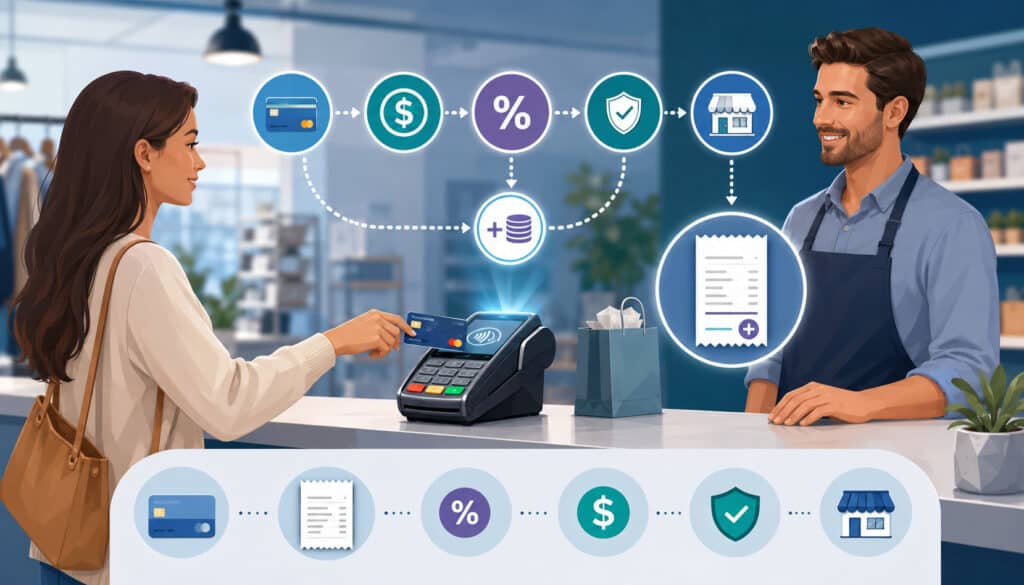
A surcharge program adds a fee only when a customer chooses an eligible credit card. The fee should be disclosed before payment and shown on the receipt. The POS system, terminal, virtual terminal, or payment gateway must be able to distinguish eligible credit cards from debit and prepaid cards.
In a card-present retail setting, the customer may see signage at the entrance and register explaining that a credit card surcharge applies. When the customer presents a card, the POS determines whether the card is eligible. If it is a credit card, the surcharge appears before the customer confirms payment. If it is a debit or prepaid card, the surcharge should not apply.
In card-not-present transactions, the disclosure must be just as clear. Ecommerce sellers should show the fee before the customer completes checkout.
Service providers using emailed invoices or payment links should explain the fee in the invoice terms and show the final payment amount before authorization. Phone order and mail order businesses should provide disclosure before taking payment details.
A surcharge program also affects refunds. If a customer returns an item or cancels a service, the business must know whether the surcharge is refunded with the original transaction. Refund handling should match card network rules, processor requirements, and posted policies. Inconsistent refunds can lead to complaints and disputes.
Surcharging may also affect tips in restaurants, salons, and service businesses. If a customer adds a tip, the merchant should know whether the surcharge is calculated on the pre-tip amount, total amount, or according to the processor’s specific setup. This should not be guessed at the counter.
Receipt Disclosure
Receipt disclosure is a key part of a surcharge program. The surcharge should appear clearly on the customer receipt, and the line item should be understandable. If the receipt simply says “fee,” “adjustment,” or “service charge,” the customer may not recognize that it relates to credit card processing.
A clear receipt helps in several ways. It supports transparency, reduces customer confusion, and gives staff a consistent reference when answering questions. It also helps finance teams reconcile sales, taxes, tips, refunds, and merchant processing fees.
Receipt disclosure should match what was disclosed before payment. If signage says “3% credit card surcharge,” the receipt should not say “convenience fee” unless the program is actually structured as a convenience fee under applicable rules. Mixing terms can create compliance and customer service problems.
Merchants should test receipts before launching. Run small transactions with different payment methods: credit card, debit card, prepaid card, cash, keyed transaction, invoice payment, and refund. Review every receipt format, including printed receipts, emailed receipts, online receipts, and customer portal receipts.
POS Setup
POS setup can make or break a surcharge program. The system must calculate the correct amount, apply it only to eligible transactions, show it before authorization, and itemize it properly on the receipt.
Businesses should ask their payment processor or POS provider specific questions:
- Can the system identify debit, prepaid, and credit cards automatically?
- Does the system support card-present and card-not-present surcharge rules?
- Can the surcharge amount be capped correctly?
- Is the surcharge sent in the required transaction data field?
- How are refunds handled?
- How are tips, taxes, discounts, split payments, and partial refunds handled?
- What receipt language is used?
- Can surcharge reporting be separated on the merchant statement?
A manual workaround is risky. Cashiers should not be responsible for deciding whether a card is eligible for a surcharge. Ecommerce teams should not add a generic “processing fee” plug-in without confirming whether it follows card network rules and state rules.
Rules, Disclosures, and Compliance Considerations

Compliance is where many cash discount and surcharge programs become complicated. Rules can vary by state, card network, payment type, transaction method, business category, processor setup, and disclosure practice. For surcharge programs, merchants should review card network rules carefully.
Visa’s guidance says surcharging is limited to credit cards only, debit and prepaid cards cannot be surcharged, the amount is limited to the merchant discount rate for the applicable credit card or 3%, whichever is lower, and disclosures are required at entry, point of sale or transaction, and on every receipt.
Mastercard’s guidance also discusses advance notice, disclosure requirements, brand-level and product-level surcharging, and restrictions on debit and prepaid cards.
State rules add another layer. Some states restrict or prohibit certain surcharge practices, while others allow them with specific disclosure requirements. Rules may also change, and court decisions or legislative updates can affect how they apply. Multi-location businesses must be especially careful because a payment policy that works in one state may not work in another.
Cash discount compliance is also not automatic. A program can become problematic if the posted price is unclear, if the card price is not displayed properly, if the “discount” is actually added as a fee, or if receipt language conflicts with signage.
Consumer protection expectations are also moving toward greater price transparency. The Federal Trade Commission’s guidance on unfair or deceptive fees emphasizes upfront disclosure of total prices in covered contexts and clear disclosure of excluded charges before payment.
While merchants should consult counsel for how specific rules apply to their business, the broader lesson is simple: surprise fees create risk.
Card Network Rules
Card network rules are not the same as state law, but merchants that accept cards agree to follow network operating rules through their merchant account. Violating those rules can lead to warnings, fines, required remediation, or processing problems.
For surcharge programs, card network rules typically address which cards can be surcharged, how much can be charged, how the surcharge must be disclosed, whether advance notice is required, and how the surcharge appears in transaction data. These rules may also distinguish between brand-level and product-level surcharging.
For cash discount programs, network guidance often focuses on whether the cardholder sees the full card price clearly. If the final card total is created by adding a fee to the posted price, the program may be treated as a surcharge even if the merchant calls it a cash discount.
A business should not rely only on a sales pitch or a generic software setting. Ask the payment processor for written documentation explaining how the program works under current card network rules. Finance teams should keep that documentation with merchant account records, signage files, receipt samples, and POS setup notes.
State Rules
State rules can affect surcharge programs, cash discount compliance, consumer disclosures, advertised pricing, and receipt practices. Some states may restrict surcharging, require specific language, limit the amount, or require the total price to be displayed in a certain way.
Because state rules can change, merchants should not copy another business’s policy. A restaurant in one state, a salon in another state, and an ecommerce seller serving many states may have different obligations. Multi-location businesses should review rules by merchant outlet location and by transaction type.
It is also important to distinguish legality from card network acceptance. A practice may be allowed under state law but still conflict with network rules or processor terms. The reverse can also be true: a network may allow surcharging in general, but state rules may restrict it in a specific location.
Legal counsel, tax professionals, and payment compliance specialists can help businesses evaluate requirements. This is especially important for regulated industries, high-ticket service providers, recurring billing businesses, healthcare practices, repair shops, and ecommerce sellers with customers in many states.
Customer Experience and Payment Transparency
Customer experience is often the deciding factor in the cash discount vs surcharge debate. A payment policy may look good on paper but still frustrate customers if it feels hidden, punitive, or confusing.
Customers tend to care about three things: what they are paying, why they are paying it, and whether they had a fair chance to choose another option. Payment transparency builds trust because it respects the customer’s decision-making process.
A cash discount program may be easier to present positively because it offers savings. For example, “Cash price available” or “Save when paying cash” feels different from “Credit card fee applies.” However, cash discounting can still create frustration if the customer sees a lower price advertised and only learns later that the lower price is not available with a card.
A surcharge program can be accepted by customers when it is disclosed early and explained clearly. This is especially true in industries where customers understand processing costs, such as professional services, B2B invoices, contractors, automotive repair, and higher-ticket transactions.
It may be harder in competitive retail or quick-service restaurant environments where speed and simplicity matter.
Businesses should also consider customer payment options. If most customers prefer cards because of rewards, budgeting, fraud protection, or convenience, a surcharge may feel like a penalty. If many customers already pay cash, a cash discount may feel natural.
Customer Communication
Good customer communication is practical, consistent, and calm. Staff should avoid blaming customers for using cards or making statements that sound like the fee is outside the business’s control. Customers know the business chose its payment policy.
A useful script for a cash discount program might be: “The card price is listed, and we offer a lower cash price at checkout.” A useful script for a surcharge program might be: “A credit card surcharge applies to eligible credit card payments and is shown before you approve the transaction.”
For invoices, include a short payment note near the total. For ecommerce, show the fee or discount before the final payment button. For restaurants, place language on menus or guest checks. For retail, use signage at the entrance and register.
Customer communication should also explain alternatives. If cash, debit, check, ACH, or another payment method avoids the fee, say so clearly. The goal is not to discourage cards entirely but to let customers choose with full information.
Chargebacks, Refunds, and Disputes
Payment transparency can reduce disputes. Customers who feel surprised by fees may complain, leave negative reviews, or dispute the transaction. Even when a dispute is not valid, it still takes time to respond.
Chargebacks may arise when customers do not recognize a surcharge, believe a fee was hidden, or think the final amount was higher than authorized. Businesses should keep records showing that the fee or discount was disclosed before payment. Helpful records may include signage photos, receipt samples, checkout screenshots, invoice templates, and POS logs.
Refunds need equal attention. If a customer returns a product, cancels a booking, or receives a partial refund, the business should know how the cash discount or surcharge is treated. A refund policy should be consistent with card network rules, processor terms, state rules, and customer-facing disclosures.
For a related operational topic, this guide to understanding chargebacks can help merchants think through disputes and documentation.
Fees, Pricing, and Cost Recovery Considerations
Cash discount and surcharge programs are often discussed as cost recovery tools, but merchants should look beyond the headline fee. The real question is how the program affects total economics, customer behavior, and administrative complexity.
Merchant processing fees usually include several components. Interchange fees are paid through the payment system to card-issuing banks. Assessment fees are charged by card networks.
Processor markup goes to the payment processor or merchant services provider. Other costs may include monthly fees, statement fees, PCI-related fees, gateway fees, batch fees, chargeback fees, equipment fees, and transaction fees.
A surcharge program may offset some credit card processing costs, but it may not eliminate all merchant processing fees. A cash discount program may encourage more cash payments, but it can also affect average ticket size, cash handling costs, reconciliation time, employee procedures, and customer preferences.
Businesses should calculate their effective rate before making a decision. The effective rate is generally total processing fees divided by total card volume.
Reviewing a merchant statement can show whether costs are driven mostly by credit cards, debit card payments, card-not-present transactions, rewards cards, keyed entries, chargebacks, or processor markup.
A business should also consider cash handling. Cash can reduce card fees, but it introduces other costs: drawer balancing, bank deposits, theft risk, counterfeit risk, employee errors, slower checkout in some settings, and accounting procedures.
For more background on the fee components merchants see on statements, this educational resource on average fees for credit card processing explains interchange, assessments, and processor fees.
Merchant Statement Review
Before choosing a cash discount or surcharge program, review at least three recent merchant statements. Look at total card sales, total fees, average ticket, card mix, debit volume, credit volume, card-present volume, card-not-present volume, chargebacks, monthly fees, and effective rate.
A restaurant with many small card-present debit transactions may not have the same cost profile as a contractor accepting large rewards credit cards through emailed invoices. An ecommerce seller with higher card-not-present risk may see different fees than a local retail shop using a chip card reader.
Finance teams should also review whether fees are pass-through, flat-rate, tiered, subscription-based, or bundled. A surcharge or cash discount program does not fix a confusing pricing model by itself.
Sometimes a merchant can reduce costs by improving interchange qualification, using better data fields, updating payment gateway settings, or negotiating processor markup.
Merchant statement review also helps set realistic expectations. If the business expects to recover 3% but its eligible credit card volume is only part of total sales, the actual impact may be lower. If customers change behavior, sales mix may shift in ways that need monitoring.
Pricing Strategy
Cash discount fees, surcharges, and card prices should be part of a broader pricing strategy. A business should ask whether it wants to separate payment costs at checkout or build those costs into overall prices.
Building costs into prices is simple for customers, but it means cash and debit customers may effectively help cover credit card acceptance costs. Surcharging separates the cost for eligible credit card users, but it may create friction. Cash discount pricing rewards lower-cost payment behavior, but it requires strong disclosure and careful POS setup.
Competitive positioning matters too. If nearby businesses do not add fees, a surcharge may stand out. If cash discounts are common in the local market, customers may accept them more easily. High-ticket service businesses may have more room to explain card costs than a fast-moving convenience store or coffee shop.
A business should also avoid overcorrecting. A payment policy that saves some processing costs but reduces repeat visits, tips, online conversions, or customer satisfaction may not be worth it. Cost recovery should be measured alongside customer retention and sales conversion.
Cash Discount, Surcharge, Convenience Fee, and Dual Pricing Differences
Payment terms are often used interchangeably, but they do not mean the same thing. Confusing the terms can lead to customer frustration and compliance risk.
A cash discount lowers the price for customers who pay with cash. A surcharge adds a fee to eligible credit card payments. A convenience fee is generally a fee charged for using an alternative payment channel, such as paying online instead of in person, where allowed and properly structured.
A service fee may apply in specific environments and categories, depending on network rules and provider setup. Dual pricing displays two prices, usually a cash price and a card price.
A non-cash adjustment is a term some businesses use when a card or non-cash price differs from the cash price. The term itself does not determine compliance. What matters is how the price is displayed, when the customer is informed, what payment types are affected, and whether the setup follows applicable rules.
A credit card convenience fee is especially easy to confuse with a credit card surcharge. A surcharge is based on the customer using an eligible credit card. A convenience fee is usually tied to the convenience of a different payment channel, not simply the use of a credit card.
For example, a business that normally accepts in-person payments may charge a properly disclosed fee for an online payment option if allowed under applicable rules. Merchants should not label a surcharge as a convenience fee just because it sounds more customer-friendly.
Convenience Fees
Convenience fees are not a workaround for surcharge rules. They are a separate category with separate requirements. In many cases, a convenience fee must be tied to an alternative payment channel rather than the card type itself.
For example, a school, utility, government office, or service provider may offer an online payment portal as an alternative to paying by mail or in person.
If a fee applies for using that channel, it may be described as a convenience fee if the program is structured correctly. However, simply adding a fee whenever a customer uses a credit card is usually a surcharge, not a convenience fee.
The difference matters because card network rules may treat the two fee types differently. Receipt language, disclosure language, eligible payment methods, and business categories may also differ. Businesses should ask their processor which fee type their system supports and what rules apply.
A convenience fee should be disclosed before payment, included in the final amount, and described accurately. Customers should understand what convenience they are paying for, whether another payment channel is available, and whether the fee is optional.
Non-Cash Adjustment
A non-cash adjustment is often used to describe a pricing difference when customers do not pay with cash. The phrase may appear on receipts, POS systems, or signage. However, using the phrase does not automatically make a program compliant.
If a business posts a low price and then adds a non-cash adjustment at checkout for card payments, customers may view it as a surcharge. Depending on the payment type and disclosure, card networks or regulators may view it similarly. The substance of the transaction matters more than the label.
For a true cash discount structure, the card price should generally be clear, and the discount should reduce the price for cash. If the customer only discovers the higher non-cash total after presenting a card, the program may create risk.
Businesses using non-cash adjustment language should review every customer-facing touchpoint: shelf tags, menus, invoices, online carts, terminal prompts, printed receipts, emailed receipts, and refund receipts. The wording should be consistent and understandable.
Dual Pricing
Dual pricing means showing two prices, usually a cash price and a card price. This model can be very transparent when done correctly because customers can compare payment options before checkout.
Gas stations have used versions of dual pricing for years, but the concept can also apply to restaurants, retail stores, salons, repair shops, and service businesses. A menu might show “cash” and “card” columns. A service estimate might list “cash/check price” and “card price.” A POS display might show both totals before payment.
Dual pricing can reduce surprise because the customer sees both prices early. However, it can also create operational complexity. Product tags, menus, ecommerce prices, printed estimates, taxes, discounts, loyalty rewards, tips, and receipts all need to match the pricing structure.
The best dual pricing programs are simple. Customers should not need to calculate percentages in their heads. The business should display actual prices wherever practical.
Pros and Cons for Retail, Restaurants, and Service Businesses
The right payment strategy depends heavily on the business model. A policy that works for a professional service invoice may not work for a fast-casual restaurant. A retail shop with frequent small transactions may need a different approach than an auto repair business with large tickets.
Retail businesses often care about speed, signage, shelf pricing, and customer perception. Restaurants care about menus, tips, table service, guest checks, online ordering, and staff explanations. Service businesses care about invoices, deposits, recurring billing, payment links, and larger card-not-present payments.
Cash discount programs can work well for businesses with a meaningful number of cash-paying customers. They may be less useful for ecommerce sellers or professional services where customers rarely pay cash.
Surcharge programs may work better where customers pay larger invoices by credit card and understand the cost tradeoff, but they require strict control over eligible card types and disclosures.
Businesses should also consider brand positioning. A premium service provider may not want customers thinking about fees at checkout. A neighborhood repair shop may find customers appreciate a cash price. A restaurant may need to balance cost recovery with tipping behavior and guest satisfaction.
Retail Use Cases
Retail stores often have the advantage of visible signage and face-to-face checkout. A cash discount program can be explained at the entrance, on shelf tags, near the register, and on receipts. Customers can choose cash before the transaction is complete.
Retailers with small average tickets should think carefully about speed. If every customer asks about the price difference, checkout lines may slow down. Clear signage and simple staff scripts reduce that problem.
A surcharge program in retail may be more sensitive. Customers buying everyday items may react negatively to a fee added at the register. If the business chooses surcharging, the POS must identify eligible credit cards and exclude debit and prepaid cards automatically.
Retailers should also review returns. If a customer returns an item purchased with a credit card surcharge, the refund process should be clear. Store credit, exchanges, partial refunds, and split-tender transactions need written procedures.
Restaurant Use Cases
Restaurants face unique challenges because pricing appears in multiple places: menus, online ordering systems, delivery platforms, guest checks, handheld terminals, and final receipts. Tips and service charges can further complicate the customer’s understanding.
A cash discount program may work for counter-service restaurants, diners, cafes, food trucks, and local establishments where customers often carry cash. The menu or counter sign should clearly explain the card price and cash price. Staff should be trained to answer questions before the customer pays.
Surcharge programs require extra caution in restaurants because customers may not see the final payment screen until after the meal. If the fee appears only when the check arrives, it can feel like a surprise. Restaurants should disclose any credit card surcharge on menus, at the point of entry, and on the check before payment.
Tip calculations should also be tested. A customer should understand whether the fee applies before or after tip, and the receipt should make the calculation clear.
Service Business Use Cases
Service businesses often have more flexibility because payment happens through estimates, invoices, contracts, online portals, or payment links. This gives the business more room to explain payment options before the customer pays.
A contractor, repair shop, consultant, medical office, accounting firm, or salon may use a cash discount, ACH option, check option, or surcharge program depending on customer expectations.
Higher-ticket transactions can make processing fees more noticeable, so customers may be more willing to choose a lower-cost method if the options are presented clearly.
For recurring billing, businesses should be careful. If a surcharge or card price applies to recurring payments, the customer should authorize the amount and understand whether fees may change. Stored card transactions, subscriptions, retainers, and installment payments may require additional disclosures.
Service businesses should also coordinate with accounting. Invoices, receipts, deposits, refunds, sales tax, tips, and finance reports should all reflect the chosen payment policy accurately.
Common Mistakes Businesses Should Avoid
The most common mistake is confusing cash discounting with surcharging. A business may believe it has a cash discount program because the POS vendor uses that label, but the actual receipt may show an added card fee. Labels matter less than structure.
Another frequent mistake is applying surcharges to debit cards. As noted earlier, major card network guidance generally prohibits surcharging debit and prepaid cards, even if the debit transaction is processed without PIN entry. A POS system that cannot reliably identify card type can create serious risk.
Poor disclosure is also common. A small sign behind the counter, vague receipt language, or a fee that appears only after the customer taps a card can damage trust. Disclosure should happen before payment, not after authorization.
Businesses also make mistakes with tax settings. If the POS calculates tax incorrectly because of discounts, fees, or dual pricing, the business may create accounting and tax reporting problems. Merchants should ask a qualified tax professional how their setup should handle taxable amounts.
Other common mistakes include failing to train staff, using inconsistent language across channels, not checking state rules, ignoring refund procedures, forgetting ecommerce checkout disclosure, and failing to review merchant statements after launch.
Payment Processor Support
Payment processor support is essential. A provider should be able to explain whether the program is a cash discount, surcharge, convenience fee, service fee, dual pricing model, or another structure. They should also explain which payment types are eligible and how the POS handles them.
Ask for documentation, not just verbal reassurance. A business should understand how the program works for chip cards, tap payments, swiped cards, keyed transactions, invoices, payment links, ecommerce checkout, refunds, tips, partial refunds, and split tenders.
Processor support should also include reporting. Merchants need to reconcile surcharge amounts, discounts, taxes, tips, and net deposits. If the merchant statement is hard to understand, finance teams may struggle to measure whether the program is actually helping.
If a processor cannot answer basic compliance and setup questions, that is a warning sign. Payment policies affect customer experience, legal risk, and revenue reporting. They deserve careful implementation.
Staff Training
Staff training is not optional. Cashiers, servers, front-desk employees, technicians, billing teams, and customer support staff should understand the payment policy before customers ask questions.
Training should cover what the program is, which payment methods are affected, where the policy is disclosed, how to explain it, how to handle complaints, and when to escalate. Staff should not improvise explanations such as “the bank makes us charge this” or “everyone has to pay it.” Inaccurate explanations can create mistrust.
A simple internal FAQ can help. Include examples for cash, credit card, debit card, gift card, ACH, check, online payment, refunds, and split payments. For restaurants, include tip examples. For service businesses, include invoice examples.
Managers should also monitor early feedback. If customers keep asking the same question, the signage or checkout language probably needs improvement.
Cash Discount vs Surcharge Checklist for Merchants
Before implementing either program, business owners and finance teams should slow down and review the operational details. Cash discount and surcharge programs affect more than the payment terminal. They affect pricing strategy, customer communication, accounting, tax handling, compliance, refunds, disputes, and employee training.
Use this checklist to evaluate the right approach:
- Do customers currently ask for cash, check, ACH, or debit options?
- What percentage of sales are credit card, debit card, cash, ACH, check, or card-not-present?
- What is the business’s effective processing rate?
- Are most transactions small retail purchases or larger invoice payments?
- Would customers view a fee as reasonable or frustrating?
- Can the POS system support the program correctly?
- Can the payment gateway show disclosures before payment?
- Can the system identify debit and prepaid cards?
- Are state rules clear for every business location?
- Has the business reviewed card network rules?
- Has the business reviewed tax treatment with a qualified professional?
- Are receipts, invoices, menus, signs, and online checkout pages consistent?
- Are employees trained?
- Are refund and chargeback procedures documented?
- Will the merchant statement show enough detail to measure results?
A business should also decide how it will measure success. Lower card processing expense is only one metric. Also review customer complaints, sales conversion, repeat visits, average ticket, cash handling time, chargebacks, refunds, and staff feedback.
Compliance Checklist
A practical compliance checklist should include both legal and operational items. Start with state rules, card network rules, and merchant account terms. Then review customer-facing disclosures and payment system behavior.
For a surcharge program, confirm that debit and prepaid cards are excluded, the surcharge is capped correctly, required notice is completed if applicable, and receipts show the surcharge clearly.
For a cash discount program, confirm that posted pricing clearly communicates the card price and cash discount, and that the customer is not surprised by a fee after choosing a card.
For both programs, review ecommerce checkout, invoices, recurring payments, mobile payments, and refunds. A policy that works at a physical register may fail online if the payment gateway does not show the right disclosure before payment.
Do not forget documentation. Keep copies of provider instructions, legal review notes, signage, receipt samples, customer scripts, and screenshots. Documentation is valuable if a customer complains, a card network inquiry occurs, or an internal audit asks how the program was approved.
Decision Checklist
A decision checklist helps business owners compare business fit, not just rules. If customer relationships are highly sensitive, a cash discount may be easier to explain than a surcharge. If transactions are large and customers often choose rewards credit cards, a surcharge may be easier to justify if allowed and properly disclosed.
If the business is mostly online, cash discounting may be less practical unless ACH, check, or other lower-cost payment options are available. If the business is mostly local and cash-friendly, a cash discount payment program may fit naturally.
If the POS system cannot handle eligibility rules, do not force a workaround. If staff cannot explain the program in a simple and consistent way, delay launch and improve training. If the business operates across multiple states, get location-specific guidance before using one policy everywhere.
A good payment strategy should be understandable, measurable, and sustainable. If it creates more confusion than savings, it may not be the right fit.
What is the difference between a cash discount and a surcharge?
A cash discount gives customers a lower price when they pay with cash or another approved lower-cost method. A surcharge adds an extra fee to eligible credit card payments. The difference is whether the price goes down for cash or goes up for credit card use.
This distinction affects customer perception, posted pricing, checkout disclosure, receipt language, POS setup, and compliance. A business should review the actual structure of the program rather than relying only on the name used by a provider or software setting.
Is a cash discount program the same as a surcharge?
No. A cash discount program and a surcharge program are related cost-recovery strategies, but they are not the same. A cash discount reduces the price for cash-paying customers. A surcharge adds a fee to eligible credit card transactions.
If a business posts one price and then adds a fee for card use at checkout, that may look like a surcharge even if the receipt calls it a cash discount or non-cash adjustment. The structure, timing, and disclosure determine how the program is likely to be viewed.
Can businesses surcharge debit cards?
Major card network rules generally do not allow surcharges on debit cards or prepaid cards. This is true even when a debit card is processed through a signature route or the customer selects a “credit” prompt at the terminal.
Businesses considering a card surcharge program should make sure their POS system or payment gateway can automatically identify ineligible cards. Staff should not manually guess whether a card is debit, prepaid, or credit.
What disclosures are needed for surcharge programs?
A surcharge program usually requires clear disclosure before payment and itemized receipt disclosure. Card network guidance may require signage at the point of entry, point of sale, or transaction screen, as well as a clear surcharge line on the receipt.
Online sellers and invoice-based businesses should disclose the surcharge before the customer submits payment. State rules, card network rules, and processor requirements may add specific language, timing, or formatting requirements.
How does a cash discount program work at checkout?
In a cash discount program, the customer sees the standard or card price and receives a lower price when paying cash. The POS system applies the discount, and the receipt should show the pricing clearly.
Some businesses use dual pricing, where both cash and card prices are displayed side by side. Others show the standard price and explain that a cash discount is available. In either case, customers should understand the price difference before they pay.
Are cash discount and surcharge rules the same everywhere?
No. Rules can vary by state, card network, payment type, transaction method, provider, business category, and merchant account setup. A policy that works for one business may not work for another.
Businesses should review state rules, card network rules, processor terms, POS capabilities, tax treatment, and disclosure practices before launching a program. Multi-location and ecommerce businesses should be especially careful.
How can businesses explain these programs to customers?
Use clear, direct language. For a cash discount program, a business might say, “The listed price is the card price, and a cash discount is available.” For a surcharge program, a business might say, “A credit card surcharge applies to eligible credit card payments and will be shown before you pay.”
Staff should be trained to answer questions calmly. Signs, menus, invoices, payment pages, and receipts should all use consistent wording.
What mistakes should merchants avoid with cash discounting or surcharging?
Avoid applying surcharges to debit cards, hiding fees until after payment, using vague receipt language, confusing convenience fees with surcharges, failing to check state rules, and launching without staff training.
Also avoid assuming the POS system is configured correctly without testing. Run test transactions, review receipts, check merchant statement reporting, and document refund procedures before going live.
Conclusion
Choosing between a cash discount vs surcharge program is not just a question of recovering merchant processing fees. It is a broader decision about pricing strategy, customer experience, payment transparency, compliance, and operational control.
A cash discount program generally offers a lower price to customers who pay with cash. It may be easier to communicate positively, especially for retail stores, restaurants, salons, repair shops, and local service businesses where cash remains common.
However, it still requires clear posted pricing, accurate checkout disclosure, proper receipt language, tax review, and staff training.
A surcharge program adds a fee to eligible credit card transactions. It may work well for businesses with larger invoices, professional services, B2B payments, and customers who understand the cost of card acceptance.
However, it is usually more rule-sensitive. Merchants must pay close attention to credit card surcharge limits, debit card restrictions, card network rules, state rules, receipt disclosure, and processor setup.
The best choice depends on your customers, transaction mix, average ticket, payment methods, POS system, state rules, and tolerance for checkout friction. Review your merchant statement, calculate your effective rate, talk with your payment processor, test your POS configuration, document your policy, and train your team before making changes.
Above all, keep the customer experience clear. Whether you choose cash discount pricing, dual pricing, a surcharge program, or a different payment strategy, customers should know what they will pay before they authorize the transaction.
Transparency protects trust, reduces disputes, and helps businesses manage payment processing costs in a more professional and sustainable way.