
By John Burroughs June 14, 2026
Payment processing fees are the costs businesses pay to accept electronic payments. These fees can apply when a customer pays with a credit card, debit card, digital wallet, mobile payment, online checkout, virtual terminal, or other supported payment method.
For many businesses, these costs are a regular operating expense, just like rent, payroll, software, insurance, or inventory.
The challenge is that payment processing fees are not always shown as one simple charge. A merchant statement may include interchange fees, assessment fees, processor markup, monthly fees, statement fees, PCI compliance fees, payment gateway fees, chargeback fees, batch fees, equipment costs, and other line items.
Some charges are tied directly to each sale, while others are billed monthly, annually, or only when a specific event occurs.
Understanding these fees matters because small differences can add up quickly. A retail store with thousands of card-present transactions, a restaurant with tips and tabs, an ecommerce seller with card-not-present risk, a service provider using keyed transactions, and a subscription business with recurring billing may all pay different amounts even if their monthly sales volume looks similar.
This guide explains how payment processing fees work, who receives the money, what affects pricing, how to compare pricing models, and how to review a merchant statement with more confidence.
It is designed for business owners, merchants, ecommerce sellers, retailers, restaurants, service providers, startups, finance teams, and decision-makers who want a practical understanding of payment processing costs without getting lost in industry terminology.
What Are Payment Processing Fees?
Payment processing fees are the charges a business pays to accept non-cash payments. Most commonly, this means card payment fees for credit card and debit card transactions.
It can also include online payment processing fees, payment gateway fees, ACH payment fees, mobile payment fees, and costs related to digital wallets, recurring billing, or virtual terminal transactions.
When a customer taps, dips, swipes, keys in, or enters payment details online, several systems work together behind the scenes. The transaction must be authorized, routed, approved or declined, captured, settled, funded, recorded, and secured.
Payment processing fees help cover the cost of that infrastructure, the risk taken by financial institutions, network access, fraud tools, settlement, reporting, compliance support, and processor services.
From a merchant’s point of view, these fees usually appear in a few main ways:
- A percentage of each transaction
- A fixed per-transaction fee
- A monthly account or service fee
- A fee for online gateway access
- A fee for chargebacks or retrieval requests
- A fee for PCI compliance support or non-compliance
- Hardware or software-related costs
- Statement, batch, annual, or minimum monthly fees
For example, a card transaction may include a percentage rate plus a small fixed fee. A business might also pay a monthly merchant account fee, a gateway monthly fee for ecommerce payments, and occasional chargeback fees if customers dispute transactions.
Payment processing fees are not always bad or avoidable. They are part of accepting convenient payment methods that many customers expect. The goal is not to eliminate every fee. The goal is to understand which fees are legitimate, which fees are negotiable, which fees may be avoidable, and which fees need closer review.
A business that understands payment processing fees can make better decisions about pricing, margins, payment methods, checkout workflows, fraud prevention, reconciliation, and vendor relationships. That understanding also makes it easier to compare proposals from different merchant services providers without focusing only on the lowest-looking number.
Why Payment Processing Fees Matter for Businesses
Payment processing fees matter because they directly affect profit margins. A few basis points may seem small on a single sale, but across hundreds or thousands of transactions, the difference can be meaningful.
For businesses with tight margins, high average tickets, seasonal swings, or heavy card usage, payment processing costs deserve regular review.
A restaurant, for example, may process many smaller transactions with tips, tabs, refunds, and voids. A retailer may process a high volume of card-present transactions through a POS system. An ecommerce seller may pay more for card-not-present transactions because the card and cardholder are not physically present.
A B2B seller may process larger invoices and could benefit from providing more transaction data when eligible. A service provider may use a virtual terminal or recurring billing system, which can affect card processing fees.
Payment processing fees also matter because they influence cash flow. Some businesses receive funding the next business day, while others may experience different settlement timelines based on provider rules, risk profile, transaction type, or account setup.
Fees may be deducted daily, monthly, or before funding reaches the merchant account. If finance teams do not understand how fees are deducted, reconciliation can become confusing.
These fees also affect pricing strategy. Businesses that accept card payments must decide whether processing costs are absorbed into overall pricing, reflected in minimum purchase rules where allowed, handled through compliant surcharge or cash discount structures where applicable, or managed through operational improvements.
Rules can vary, so businesses should review legal, network, and provider requirements before changing how customers are charged.
Payment processing fees also reveal operational issues. A sudden increase in credit card transaction fees may point to more keyed transactions, more rewards cards, more international cards, missing data, downgrades, chargebacks, PCI non-compliance, or a pricing change from the processor. Without reviewing statements, these issues may go unnoticed.
Finally, understanding fees helps business owners ask better questions. Instead of asking only, “What is your rate?” a more useful question is, “What is my total effective rate after interchange, assessment fees, processor markup, monthly fees, gateway fees, PCI-related fees, chargeback fees, batch fees, equipment costs, and any other merchant account fees?”
The Main Parties Involved in Payment Processing Fees

Payment processing fees are easier to understand when you know who is involved. A card transaction may feel instant at the checkout counter, but it usually involves a customer, a merchant, a payment processor, a merchant account or acquiring bank, an issuing bank, card networks, and sometimes a payment gateway.
Each party has a role in authorization, routing, settlement, funding, security, reporting, or risk management. Not every fee goes to the payment processor. This is one reason merchant statements can be confusing. Some fees are pass-through costs set by networks or banks, while others are markup charged by the processor or merchant services provider.
Merchant, Customer, and Merchant Account
The merchant is the business accepting payment. The customer is the cardholder or account holder making the purchase. The merchant account is the account structure that allows the business to accept card payments and receive funds after transactions settle.
A merchant account is not always the same as a regular business checking account. It is part of the merchant services setup that helps route payments, manage settlement, and handle risk.
Some payment providers aggregate merchants under a shared structure, while others provide a more traditional merchant account setup. The structure can affect underwriting, pricing, funding, reporting, reserves, and account stability.
For a business, the merchant account is where processing activity is tied together. Sales, refunds, chargebacks, transaction fees, monthly fees, and funding details may all appear in merchant statements or settlement reports. Finance teams should understand how deposits from card sales match the processing activity shown in the statement.
A merchant account can be especially important for businesses with higher transaction volume, specialized payment needs, multiple locations, ecommerce activity, recurring billing, B2B payments, or card-present and card-not-present channels. The more complex the business, the more important clean reporting becomes.
Payment Processor, Acquiring Bank, and Issuing Bank
The payment processor helps move transaction information between the merchant, the acquiring bank, the card networks, and the issuing bank. It handles authorization requests, transaction routing, settlement files, security tools, reporting, and other processing functions.
The acquiring bank, sometimes called the merchant’s bank in the card acceptance flow, supports the merchant’s ability to accept card payments. The issuing bank is the financial institution that issued the customer’s credit card or debit card.
When a transaction is approved, the issuing bank confirms whether the customer has available credit or funds and whether the transaction appears valid.
A simplified flow looks like this:
- The customer presents payment information.
- The merchant’s POS system, card reader, payment gateway, or virtual terminal sends the transaction for authorization.
- The payment processor routes the request through the card network.
- The issuing bank approves or declines the transaction.
- The transaction is later captured, settled, and funded to the merchant, minus applicable fees depending on the billing setup.
Interchange fees generally go to the issuing bank. Assessment fees generally go to the card networks. Processor markup goes to the payment processor or merchant services provider. This distinction is important because not all fees are equally negotiable.
Card Networks and Payment Gateways
Card networks provide the rails that help card payments move between acquiring banks and issuing banks. They set many rules for card acceptance, including network fees, operating rules, dispute procedures, and interchange categories. Businesses do not usually negotiate directly with card networks for standard card processing fees.
A payment gateway is the technology that securely transmits payment information for online checkout, ecommerce payments, invoices, recurring billing, and virtual terminal transactions.
For online businesses, the gateway plays a role similar to a card terminal in a physical store, but it also supports features such as tokenization, encryption, fraud filters, saved payment methods, and recurring payment schedules.
Payment gateway fees may include monthly gateway access, per-transaction gateway charges, batch fees, fraud tool fees, or additional costs for advanced features.
Businesses using ecommerce platforms should understand whether gateway fees are charged by the payment processor, the ecommerce platform, a separate gateway provider, or a combination of providers.
Common Types of Payment Processing Fees
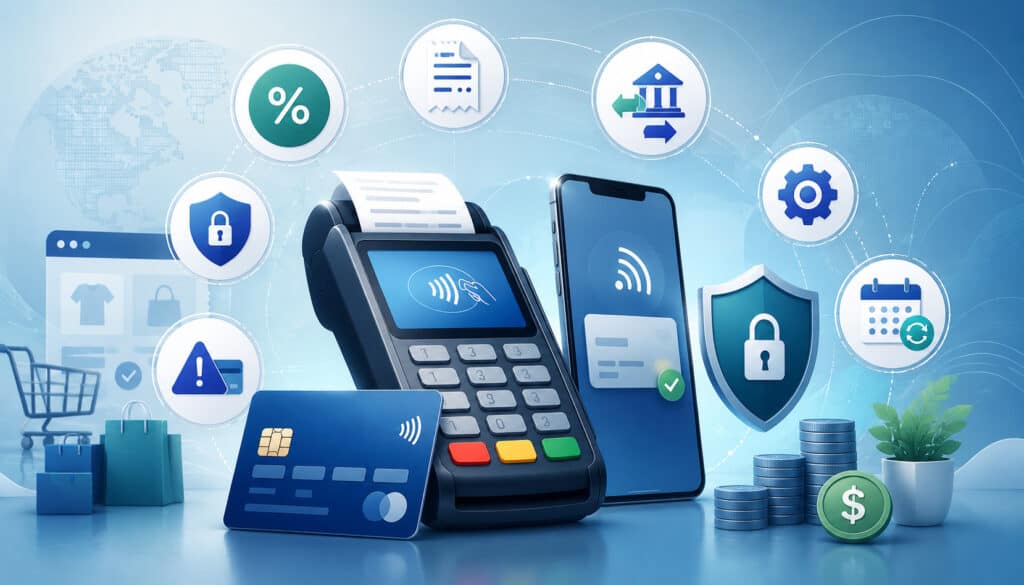
Payment processing fees are often grouped into transaction-based fees, account-based fees, technology fees, compliance fees, risk fees, and incidental fees. Some are charged every time a transaction occurs. Others are charged monthly or only when specific events happen.
The most visible fees are usually credit card processing fees and debit card processing fees. These often include a percentage of the sale plus a fixed amount.
However, the total cost of accepting payments may also include merchant account fees, payment gateway fees, monthly fees, statement fees, PCI compliance fees, chargeback fees, batch fees, equipment costs, and software-related fees.
Here is a high-level breakdown.
| Fee Type | Who Charges It | What It Covers | What Merchants Should Review |
| Interchange fees | Usually paid through the processor to the issuing bank | Issuer risk, authorization, card type, rewards, fraud exposure, transaction category | Card type, entry method, transaction data, downgrade patterns |
| Assessment fees | Card networks | Network access, brand usage, processing infrastructure | Whether listed clearly as pass-through fees |
| Processor markup | Payment processor or merchant services provider | Processor services, support, routing, reporting, margin | Percentage markup, per-transaction markup, negotiability |
| Transaction fees | Processor, gateway, or network | Per-sale authorization and processing activity | Fixed fees, small-ticket impact, transaction count |
| Monthly fees | Processor, gateway, or account provider | Account maintenance, reporting, support, platform access | Whether services match business needs |
| Payment gateway fees | Gateway or processor | Online checkout, virtual terminal, recurring billing, fraud tools | Monthly gateway fees, per-transaction gateway charges |
| PCI compliance fees | Processor or compliance provider | Compliance tools, questionnaires, scans, support | Compliance status, non-compliance penalties, scope |
| Chargeback fees | Processor, acquirer, or dispute system | Dispute handling and administrative processing | Chargeback count, reason codes, prevention steps |
| Batch fees | Processor or gateway | Daily settlement batch submission | Frequency, amount, duplicate costs |
| Equipment costs | Hardware provider, processor, or POS vendor | Card reader, terminal, POS system, accessories | Lease terms, ownership, replacement costs |
This table is not exhaustive. Merchant services fees may also include AVS fees, voice authorization fees, retrieval fees, annual fees, minimum monthly fees, early termination fees, software fees, next-day funding fees, statement fees, regulatory fees, cross-border fees, chargeback monitoring fees, tokenization fees, and other account-specific charges.
Credit Card Processing Fees
Credit card processing fees are the charges businesses pay when customers use credit cards. These fees are often higher than debit card processing fees because credit card transactions can involve issuer credit risk, rewards programs, fraud exposure, and different interchange categories.
The cost of a credit card transaction can vary based on the card type, transaction method, merchant category, pricing model, processor markup, and whether the card is present.
A basic card used in person may cost less than a premium rewards card used online. A properly dipped or tapped transaction may cost less than a keyed transaction because the risk profile is different.
Credit card merchant fees are not one single fee. They usually include interchange fees, assessment fees, and processor markup. Additional costs may apply if the transaction goes through a payment gateway, involves international card activity, triggers address verification, is later refunded, or becomes a chargeback.
Businesses should review whether credit card transaction fees are being billed under flat-rate pricing, tiered pricing, interchange-plus pricing, or subscription pricing. The pricing model determines how easy it is to see the underlying cost components.
Debit Card Processing Fees
Debit card processing fees apply when customers pay using debit cards. These transactions may be authorized through signature debit or PIN debit networks, depending on the card, terminal, routing, and merchant setup. Debit card networks and card network rules can affect how transactions are routed and priced.
Debit transactions are often less expensive than credit transactions, but not always in a way that is obvious on a statement. Under certain rules, debit card interchange for some issuers is subject to caps and routing requirements. The Federal Reserve’s Regulation II resources provide helpful background on debit interchange and routing standards.
For merchants, the key point is that debit card processing fees can vary by routing method, card type, transaction size, PIN entry, card-present environment, and processor setup. Small-ticket businesses should pay special attention to fixed per-transaction fees because a few cents can have a larger effect on low average tickets.
Businesses should also check whether their POS system and processor support debit routing options where applicable. Routing may not always be visible to staff at checkout, but it can affect costs behind the scenes.
Transaction Fees and Monthly Fees
Transaction fees are usually charged each time a payment is authorized, captured, refunded, or processed through a gateway. They may appear as a fixed amount, such as a few cents per transaction, or as part of a percentage-plus-fixed fee structure.
Monthly fees are recurring charges for maintaining the merchant account, payment gateway, reporting tools, PCI support, customer service, or software access. A monthly fee is not automatically unfair.
For example, a business may accept a monthly platform fee if the reporting, support, reconciliation tools, or gateway features are valuable.
The issue is whether the fees are clearly disclosed and aligned with what the business actually uses. A startup with low processing volume may prefer fewer monthly fees and a predictable flat rate. A higher-volume business may accept monthly fees in exchange for lower processor markup or more detailed reporting.
Interchange Fees, Assessment Fees, and Processor Markup Explained
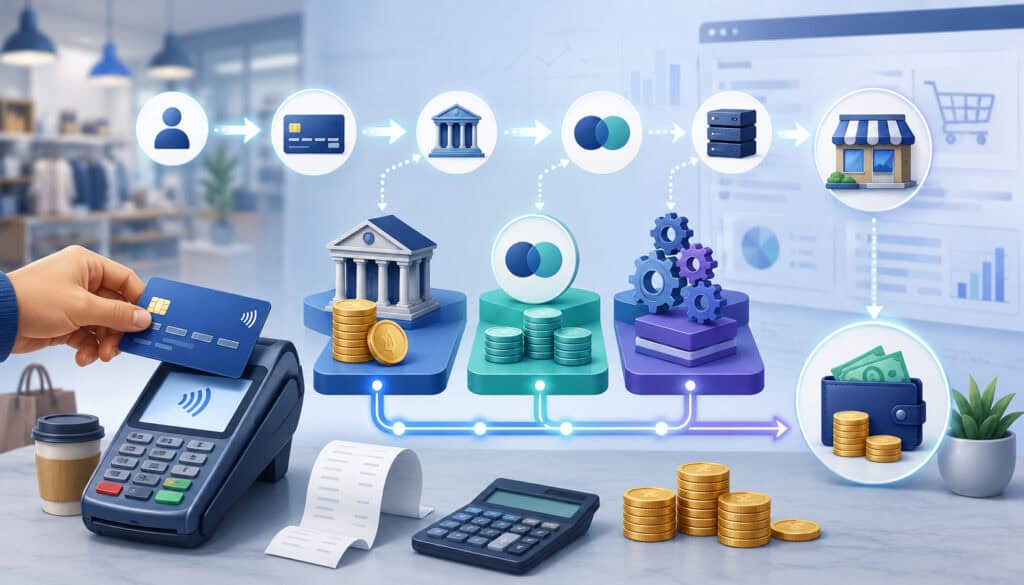
Most card processing fees can be understood through three core layers: interchange fees, assessment fees, and processor markup. Once you understand these layers, merchant statements become easier to evaluate.
Interchange fees are generally the largest component of card processing costs. They are paid to the issuing bank through the card payment system. Assessment fees are charged by card networks for access to their infrastructure. Processor markup is the amount charged by the payment processor or merchant services provider above the pass-through costs.
A helpful way to think about the fee stack is:
Total processing cost = interchange fees + assessment fees + processor markup + account, gateway, compliance, equipment, and incidental fees
That formula is not a perfect statement format, but it helps explain why two businesses may pay different totals even if their advertised rates look similar. One provider may bundle costs into a simple rate.
Another may pass through interchange and assessments separately, then add a transparent markup. Another may group transactions into tiers that make the real cost harder to identify.
For additional background, businesses can review educational resources on interchange rates and merchant services pricing and the general definition of an interchange fee.
Interchange Fees
Interchange fees are paid to the bank that issued the customer’s card. They help compensate the issuing bank for card program costs, authorization, risk, fraud exposure, and other responsibilities. In practice, interchange rates vary by card type, transaction method, merchant category, and data quality.
A rewards credit card may carry a different interchange category than a standard debit card. A card-not-present ecommerce transaction may have a different rate than a card-present tapped transaction. A business that keys in card numbers manually may trigger a higher-cost category than one that uses chip, tap, or swipe technology properly.
Interchange fees are generally not negotiated directly by individual merchants. However, merchants can influence which interchange categories their transactions qualify for by using proper equipment, entering complete transaction data, settling batches on time, using address verification for online transactions, and reducing unnecessary keyed transactions.
B2B merchants may also need to understand Level II or Level III data when eligible. Providing more invoice and tax data can sometimes help qualifying commercial card transactions process under more favorable categories. For more context, see this guide on qualifying for Level III processing rates.
Assessment Fees
Assessment fees are charged by card networks. These fees help cover network access, brand usage, authorization routing, security programs, and payment network infrastructure. They are usually much smaller than interchange fees, but they still contribute to total payment processing costs.
Assessment fees may appear under different labels on merchant statements. Some are percentage-based, while others may be fixed or triggered by certain transaction types. A merchant statement may show network access fees, brand usage fees, or other network-related line items.
Like interchange fees, assessment fees are generally pass-through costs rather than negotiable processor markup. However, merchants should still review them. Clear statements should distinguish network-related charges from processor-controlled charges. If all fees are bundled together without detail, it can be difficult to confirm what is being charged and why.
Assessment fees can also vary by card network, transaction type, card-not-present environment, cross-border activity, and other factors. Businesses with online checkout, international customers, or multiple sales channels should pay extra attention to these line items.
Processor Markup
Processor markup is the part of payment processor fees that goes to the processor or merchant services provider. It helps cover customer support, transaction routing, reporting, risk tools, platform access, funding, underwriting, account maintenance, and the provider’s margin.
Unlike interchange and many assessment fees, processor markup is often negotiable. That does not mean every business will qualify for the same pricing. Markup can vary by processing volume, average ticket size, transaction mix, risk profile, chargeback history, industry category, equipment needs, integration requirements, and contract terms.
Processor markup may appear as:
- A percentage above interchange
- A fixed per-transaction fee
- A flat bundled rate
- A tiered qualified, mid-qualified, or non-qualified rate
- A monthly subscription fee plus per-transaction charges
- A combination of account fees and transaction fees
When comparing proposals, ask for the processor markup in writing. If the proposal uses interchange-plus pricing, ask for the percentage markup and fixed transaction markup. If it uses flat-rate pricing, ask what costs are included and what fees are charged separately. If it uses tiered pricing, ask what causes a transaction to move into a higher tier.
Card-Present vs Card-Not-Present Processing Costs
Payment processing fees often vary based on whether the card is physically present. Card-present transactions generally occur when the customer pays in person by tapping, dipping, swiping, or using a digital wallet at a card reader or POS system.
Card-not-present transactions occur when payment details are entered online, over the phone, through an invoice link, through recurring billing, or manually keyed into a virtual terminal.
This distinction matters because risk is different. In a card-present transaction, secure card technology can help verify the card and reduce certain fraud risks. In a card-not-present transaction, the merchant cannot physically inspect the card or interact with the chip in the same way, so the transaction may carry higher risk and higher processing costs.
Card-Present Payments
Card-present payments include swiped transactions, dipped transactions, tapped transactions, and in-person digital wallet payments. These transactions are common in retail stores, restaurants, salons, clinics, repair shops, professional offices, events, and mobile businesses using a card reader.
Card-present payments may qualify for lower card processing fees than keyed or online payments when the right equipment is used correctly. Chip and contactless transactions can also help reduce certain liability risks compared with older or manual entry methods.
Businesses should train staff to avoid unnecessary keyed transactions. If a card does not read, employees may manually enter the card number, but repeated keyed transactions can increase costs and risk. A worn-out card reader, poor internet connection, or outdated terminal may create avoidable processing issues.
Retailers and restaurants should also make sure their POS system supports tips, tabs, refunds, voids, batch settlement, contactless payments, and digital wallets in a way that matches their operations.
For businesses evaluating hardware, this overview of payment reversals and how they work can help explain why accurate transaction handling matters after the sale.
Online Payments and Ecommerce Payments
Online payments usually fall into the card-not-present category. This includes ecommerce checkout, invoice payments, customer portals, payment links, subscription billing, and digital orders. Online payment processing fees are often higher because fraud risk, identity verification, chargeback exposure, and data security responsibilities are different.
A payment gateway is usually required for online payments. Gateway features may include encryption, tokenization, address verification, CVV checks, fraud filters, stored payment credentials, recurring billing, and settlement reporting. These features may add cost, but they also help manage risk and streamline operations.
Ecommerce sellers should review gateway monthly fees, per-transaction gateway fees, fraud tool costs, chargeback fees, refund handling, and integration fees. A low processing rate may not be the lowest total cost if gateway fees, platform fees, and dispute costs are high.
Online businesses should also pay close attention to transaction descriptors, refund policies, delivery tracking, order confirmation emails, customer service response times, and fraud screening. These operational details can reduce confusion and help prevent avoidable disputes.
Mobile Payments and Keyed Transactions
Mobile payments can mean two different things. It can refer to digital wallets used by customers at checkout, or it can refer to businesses accepting payments through mobile card readers, smartphones, tablets, or field-service devices. The cost depends on whether the transaction is card-present or card-not-present.
For example, a customer tapping a digital wallet at a mobile card reader may be treated differently from a contractor typing a card number into a mobile app after a service call. The first may be a card-present contactless transaction. The second may be a keyed card-not-present transaction.
Keyed transactions often cost more because they rely on manually entered card data. They can also increase exposure to mistakes, disputes, and fraud. Service providers, mobile vendors, delivery businesses, and field teams should use secure card readers whenever possible instead of manually entering card numbers.
For fraud management, velocity checks can help identify unusual transaction patterns, such as repeated attempts, multiple declined payments, or suspicious behavior. This guide to velocity checks and fraud prevention explains how transaction monitoring can support safer payment acceptance.
Pricing Models: Flat-Rate, Tiered, Interchange-Plus, and Subscription Pricing
Payment processing fees are not only about the underlying cost. They are also about how the provider packages and presents those costs. The most common pricing models are flat-rate pricing, tiered pricing, interchange-plus pricing, and subscription pricing.
No pricing model is automatically best for every business. A startup with low volume may value simplicity. A growing retailer may need more transparency. A restaurant may need POS integration and tip support.
An ecommerce seller may care more about fraud tools, gateway performance, and chargeback management. A finance team may prefer detailed interchange reporting for reconciliation and cost analysis.
The right pricing model depends on transaction volume, average ticket size, card mix, sales channels, risk profile, administrative resources, and the business’s need for predictability or transparency.
| Pricing Model | How It Works | Possible Advantages | Possible Drawbacks |
| Flat-rate pricing | One bundled rate for many transactions | Easy to understand, predictable, useful for low volume | May cost more at higher volume or on lower-cost debit transactions |
| Tiered pricing | Transactions are grouped into pricing tiers | Simple-looking rate categories | Can be hard to audit; downgrades may increase costs |
| Interchange-plus pricing | Interchange and assessments pass through, plus a disclosed markup | More transparent, easier to compare markup | Statements can be longer and more detailed |
| Subscription pricing | Monthly membership fee plus low per-transaction markup | Can work for steady volume | Monthly fee may not fit seasonal or low-volume businesses |
Flat-Rate Pricing
Flat-rate pricing charges a single bundled rate for many transaction types, often with a percentage and fixed per-transaction fee. This model is popular because it is easy to understand. A business can estimate costs quickly without analyzing interchange tables.
Flat-rate pricing may work well for very small businesses, seasonal sellers, startups, side businesses, or merchants that value simplicity over detailed cost breakdowns. It may also reduce administrative work because statements are often easier to read.
However, flat-rate pricing can hide the difference between low-cost and high-cost transactions. A debit card transaction and a rewards credit card transaction may be charged the same merchant-facing rate even though their underlying costs differ. As volume grows, that bundling may become more expensive than a transparent cost-plus structure.
Businesses using flat-rate pricing should still review total monthly fees, card-not-present rates, keyed transaction rates, chargeback fees, refund fees, instant funding fees, hardware costs, and platform charges. “Simple” does not always mean “complete.”
Tiered Pricing
Tiered pricing groups transactions into categories such as qualified, mid-qualified, and non-qualified. The qualified rate is often the lowest advertised rate, but not every transaction qualifies for it. Rewards cards, keyed transactions, corporate cards, online transactions, missing data, or certain card types may fall into higher-cost tiers.
The main concern with tiered pricing is transparency. The processor often controls how transactions are assigned to tiers, and merchants may not easily see the underlying interchange fee, assessment fee, and processor markup. This can make it difficult to compare proposals or determine why costs changed.
Tiered pricing is not automatically inappropriate, but businesses should be careful. A low qualified rate may not matter if many transactions downgrade to more expensive tiers. A merchant statement review should look at how much volume appears in each tier, not just the rate shown on the proposal.
If a processor offers tiered pricing, ask for examples based on your real transaction mix. Also ask which card types and entry methods fall into each tier, what causes downgrades, and how card-not-present transactions are handled.
Interchange-Plus Pricing
Interchange-plus pricing separates the underlying interchange and assessment fees from the processor markup. The business pays the actual pass-through costs plus an agreed markup, such as a percentage and fixed per-transaction amount.
This model is often valued for transparency. It allows merchants to see the difference between non-negotiable pass-through fees and processor-controlled markup. It can also make it easier to compare proposals when two providers quote different markups.
The tradeoff is that statements can be more detailed. Interchange categories may vary by card type and transaction method, so the rate shown on a statement may not be a single number. Finance teams may appreciate that detail, while some small businesses may find it more complex.
Interchange-plus pricing may be useful for established businesses with meaningful card volume, mixed card types, multiple payment channels, or a need to audit merchant processing fees closely. Still, the value depends on the actual markup, monthly fees, gateway fees, and contract terms.
Subscription Pricing
Subscription pricing, sometimes called membership pricing, charges a monthly fee in exchange for lower processor markup or a reduced per-transaction charge. The business still pays interchange fees and assessment fees, but processor margin may be structured through the subscription.
This model can work for steady-volume merchants that process enough payments to justify the monthly fee. It may be less attractive for seasonal businesses, very low-volume merchants, or businesses with unpredictable sales.
When evaluating subscription pricing, calculate the breakeven point. Compare the monthly subscription fee plus transaction costs against flat-rate, tiered, and interchange-plus options. Also review whether the subscription includes gateway access, PCI support, reporting tools, customer service, chargeback support, and equipment.
Payment Gateway, Equipment, PCI, and Monthly Fees
Payment processing costs often extend beyond the rate charged on each transaction. Businesses may also pay for payment gateway access, card readers, POS systems, virtual terminals, PCI compliance tools, monthly account maintenance, reporting, or software integrations.
These fees are not always a problem. Technology, security, reporting, and support have value. A restaurant may need a POS system with table management, tipping, and kitchen routing. An ecommerce seller may need a gateway with fraud filters and tokenization.
A service provider may need recurring billing and saved payment methods. A finance team may need detailed settlement reporting for reconciliation. The key is to understand what each fee covers and whether the business uses the service.
Payment Gateway Fees
Payment gateway fees apply when businesses accept payments online, through invoices, customer portals, payment links, mobile apps, or virtual terminals. A gateway securely transmits transaction data between the checkout environment and payment processor.
Common gateway-related costs include:
- Gateway monthly fees
- Gateway per-transaction fees
- Virtual terminal fees
- Recurring billing fees
- Tokenization or stored-card fees
- Fraud screening fees
- Address verification fees
- Payment link or invoice payment fees
A payment gateway can help protect cardholder data through encryption and tokenization. It can also support fraud rules, recurring billing, subscription management, customer vaults, and integration with ecommerce platforms or accounting software.
However, businesses should avoid paying for unused features. If a merchant only accepts in-person payments, a gateway fee may not be necessary unless it also uses invoicing or virtual terminal tools.
If an ecommerce business uses a platform-provided gateway, it should confirm whether it is paying both platform fees and separate gateway fees.
Equipment Costs
Equipment costs may include card readers, countertop terminals, mobile readers, receipt printers, cash drawers, barcode scanners, kitchen printers, tablets, stands, POS systems, and accessories. Equipment may be purchased, rented, leased, bundled, or provided under service terms.
The lowest upfront cost is not always the lowest total cost. A “free” terminal may require a specific contract, processing volume, service agreement, or return condition. A lease may cost more over time than purchasing equipment. A POS system may require software subscriptions, support fees, installation fees, or integration fees.
Businesses should ask:
- Who owns the equipment?
- Is there a lease, rental, purchase, or return requirement?
- What happens if the account is closed?
- Are software fees separate?
- Does the equipment support chip, tap, swipe, digital wallets, tips, refunds, and voids?
- Is the terminal compatible with the processor and POS system?
- Are replacement, warranty, or support costs included?
For retailers, restaurants, and service providers, equipment choices can also affect transaction quality. Outdated or unreliable equipment may lead to more keyed transactions, failed authorizations, delayed batches, or customer checkout friction.
PCI Compliance Fees
PCI DSS is a set of payment data security standards designed to help protect cardholder data. The PCI Security Standards Council publishes standards and resources related to payment security. Businesses that accept card payments generally have responsibilities for protecting payment data, even when they use third-party processors or gateways.
PCI-related fees can appear in different ways. Some providers charge a PCI compliance fee for tools, questionnaires, scans, or support. Some charge a PCI non-compliance fee if the merchant does not complete required validation steps. Some include PCI support in monthly services.
PCI compliance should not be treated only as a fee issue. It is also a security responsibility. Businesses should use secure payment technology, avoid storing sensitive card data improperly, restrict employee access, use strong passwords, keep software updated, and follow provider instructions for compliance validation.
The FTC’s business guidance on payments and billing also highlights the importance of authorized charges and responsible payment practices. Security, authorization, and clear billing practices all affect customer trust and dispute risk.
Chargebacks, Refunds, Batch Fees, and Other Possible Costs
Some payment processing fees do not occur on every transaction. They appear when specific events happen, such as a customer dispute, a refund, a batch settlement, a retrieval request, a failed authorization, or a special funding request.
These costs can be easy to overlook because they may not be part of the advertised rate. However, they can affect the total cost of accepting payments, especially for businesses with ecommerce orders, subscriptions, delivery, custom services, high ticket sizes, or complex refund policies.
Chargeback Fees
A chargeback occurs when a cardholder disputes a transaction through the issuing bank and the transaction is reversed or investigated through the card network process.
Chargebacks can happen because of fraud, unauthorized transactions, duplicate billing, goods not received, product dissatisfaction, unclear descriptors, subscription confusion, processing errors, or customer misunderstanding.
A chargeback fee is usually charged to the merchant for the dispute process. The merchant may also lose the sale amount, shipping costs, product cost, and administrative time. Even if the merchant wins the dispute, the chargeback fee may still apply depending on provider terms.
For general consumer background, the Consumer Financial Protection Bureau explains chargebacks in the context of disputed card purchases. Merchants should also understand provider-specific dispute rules, timelines, reason codes, and documentation requirements.
Good chargeback management starts before the dispute. Use clear billing descriptors, accurate product descriptions, signed agreements where appropriate, delivery confirmation, responsive customer service, transparent refund policies, fraud tools, and organized records. For a deeper internal resource, see this guide on chargeback representment.
Refunds and Voids
Refunds and voids are not the same. A void usually cancels a transaction before it settles. A refund returns money after the transaction has been captured or settled. The fee treatment can vary by provider, transaction type, timing, and billing terms.
Some processors return part of the processing fee when a refund is issued. Others do not. Some charge an additional transaction fee for the refund. For businesses with high return rates, trial offers, deposits, appointment cancellations, or ecommerce returns, refund policies can affect payment processing costs.
Merchants should train staff on when to void versus refund. Voiding a same-day mistake before settlement may be cleaner than refunding after settlement, but the correct process depends on the POS system and processor rules.
Clear refund policies also reduce disputes. Customers are more likely to initiate chargebacks when they cannot find a refund policy, cannot reach support, do not recognize the billing descriptor, or feel the merchant is not responding.
Batch Fees and Settlement Costs
A batch is a group of transactions submitted for settlement. Many businesses close or settle a batch at the end of the business day. A batch fee may be charged each time a settlement batch is submitted.
Batch fees are usually small, but they can add up for businesses with multiple locations, multiple terminals, or frequent settlement activity. More importantly, failing to settle batches on time can sometimes affect funding or cause transactions to qualify differently.
Settlement reports help businesses reconcile card payments with bank deposits. They may show gross sales, refunds, voids, chargebacks, fees, adjustments, and net funding. Finance teams should compare settlement reports with POS reports, gateway reports, and bank deposits.
If funding seems inconsistent, check whether fees are deducted daily or monthly, whether deposits are net or gross, whether chargebacks were deducted, whether refunds exceeded sales, or whether batches were delayed.
Other Possible Costs
Other merchant account fees may include statement fees, annual fees, monthly minimums, AVS fees, voice authorization fees, retrieval fees, regulatory fees, software fees, integration fees, early termination fees, next-day funding fees, chargeback monitoring fees, tokenization fees, and account update fees for recurring billing.
Some fees may be reasonable if they provide real value. Others may be negotiable or avoidable. The important step is to identify them and understand why they appear.
How to Read a Merchant Statement and Calculate Your Effective Rate
A merchant statement is one of the most useful tools for understanding payment processing fees. It shows transaction volume, card sales, refunds, chargebacks, card types, processing charges, monthly fees, gateway fees, assessment fees, interchange categories, and other account activity.
Unfortunately, merchant statements are not always easy to read. Some use bundled pricing, some show pass-through details, some separate deposits from fees, and some use unfamiliar abbreviations. The format depends on the processor, acquiring bank, pricing model, and reporting system.
Merchant Statement Review
Start by reviewing the summary page. Look for total sales volume, transaction count, refund volume, chargeback activity, total fees, net deposits, and billing period. Then review the detailed fee section to understand what drove the total cost.
A good statement review should answer these questions:
- How much total card volume was processed?
- How many transactions were processed?
- What was the average ticket size?
- How much was paid in total fees?
- Which fees were transaction-based?
- Which fees were monthly or fixed?
- How much was charged for gateway access?
- Were there chargebacks, retrievals, or refunds?
- Were there PCI-related fees?
- Were there statement, batch, or monthly minimum fees?
- Were many transactions keyed instead of tapped, dipped, or swiped?
- Did card-not-present volume increase?
- Did any new fees appear?
If the statement uses interchange-plus pricing, review interchange categories and processor markup separately. If it uses tiered pricing, review how much volume landed in each tier. If it uses flat-rate pricing, look for additional fees outside the flat rate.
Effective Rate
The effective rate is a simple way to estimate the total cost of accepting card payments. It shows total processing fees as a percentage of total processed volume.
The basic formula is:
Effective rate = total processing fees ÷ total card sales volume × one hundred
For example, if a business processed fifty thousand dollars in card sales and paid one thousand five hundred dollars in total processing fees, the effective rate would be three percent.
The effective rate is useful because it includes more than the advertised transaction rate. It captures transaction fees, monthly fees, gateway fees, PCI-related fees, chargeback fees, batch fees, and other processing costs if those fees are included in the total fee number.
However, the effective rate should be interpreted carefully. A business with many small transactions may have a higher effective rate because fixed per-transaction fees carry more weight.
An ecommerce business may have a higher rate because card-not-present transactions carry more risk. A business with many premium rewards cards or commercial cards may pay more than one with mostly regulated debit cards.
Statement Comparison
When comparing two merchant statements or proposals, use the same assumptions. A quote based on card-present debit transactions should not be compared against a statement with mostly ecommerce credit card sales. A proposal with low transaction rates but high monthly fees may not be cheaper for a low-volume merchant.
Ask processors to prepare a cost comparison using your actual statement data. That should include card volume, transaction count, average ticket, card mix, keyed volume, online volume, chargebacks, gateway needs, and monthly account fees.
Common Payment Processing Fee Mistakes to Avoid
Many businesses overpay or misunderstand payment processing fees because they focus on the wrong details. Others choose a provider based on convenience, then never review statements again. While not every fee can be reduced, many surprises can be avoided with better questions and regular review.
One common mistake is comparing advertised rates without comparing total costs. A processor may promote a low rate while charging separate gateway fees, statement fees, monthly minimums, batch fees, PCI fees, or higher card-not-present fees.
Another provider may show a higher simple rate but include more services. The only fair comparison is total cost under realistic transaction assumptions.
Another mistake is ignoring the transaction method. Keyed transactions, card-not-present payments, and incomplete transaction data can raise costs. Businesses should use secure card readers for in-person payments, avoid manual entry when possible, and make sure ecommerce payment forms collect the right verification data.
A third mistake is overlooking chargeback prevention. Chargebacks are not just a dispute problem; they are a fee, cash flow, inventory, and reputation problem. Clear policies, accurate descriptors, order documentation, fraud tools, and responsive support can reduce avoidable disputes.
Businesses also make mistakes with equipment contracts. A terminal lease may look inexpensive monthly but cost more than purchasing hardware. A bundled POS system may include fees that are not obvious at signup. Always review ownership, return terms, replacement costs, software charges, and compatibility.
Another issue is failing PCI validation. A business may have secure systems but still receive non-compliance fees if it does not complete required questionnaires or scans. PCI responsibilities should be assigned to a specific person or team, not left as an annual surprise.
Finally, some merchants do not calculate their effective rate. Without that number, it is hard to know whether payment processing costs are rising because of pricing changes, card mix, transaction volume, chargebacks, or operational behavior.
Payment Processing Fees Checklist for Businesses
A checklist can help businesses review payment processing fees in a structured way. Use this section when evaluating a new provider, reviewing a current merchant statement, preparing for contract renewal, or comparing merchant services fees across locations.
Start with your business profile. Identify your monthly processing volume, transaction count, average ticket size, card-present percentage, card-not-present percentage, debit versus credit mix, ecommerce volume, mobile payments, recurring billing, refunds, chargebacks, and seasonal patterns. Pricing should be evaluated against your real operating model.
Then review the fee structure. Ask whether the account uses flat-rate pricing, tiered pricing, interchange-plus pricing, or subscription pricing. Confirm whether the quoted rate includes assessment fees, processor markup, gateway fees, PCI fees, statement fees, batch fees, monthly fees, and equipment costs.
Use this checklist:
- Confirm total monthly card sales volume.
- Confirm total monthly processing fees.
- Calculate the effective rate.
- Identify interchange fees, assessment fees, and processor markup.
- Review credit card processing fees separately from debit card processing fees where possible.
- Check online payment processing fees and gateway fees.
- Review keyed transaction volume.
- Review card-present versus card-not-present volume.
- Identify monthly fees, statement fees, and minimum fees.
- Review PCI compliance fees and non-compliance fees.
- Check chargeback fees, retrieval fees, refunds, and voids.
- Review batch fees and settlement timing.
- Confirm equipment costs, lease terms, and ownership.
- Check contract term, cancellation terms, and early termination fees.
- Review funding timeline and reserve requirements if applicable.
- Confirm support availability and reporting access.
- Compare proposals using the same transaction data.
Businesses should also consider operational improvements. Train employees to use chip and contactless methods. Keep card readers updated. Settle batches daily when appropriate. Use address verification and fraud tools for online payments.
Keep refund policies visible. Make billing descriptors recognizable. Store documentation for orders, deliveries, authorizations, and customer communications.
For recurring billing, confirm that stored credentials, tokenization, account updater tools, cancellation policies, and customer notifications are handled correctly. For B2B payments, review whether additional data fields can improve transaction qualification for eligible commercial card payments.
What are payment processing fees?
Payment processing fees are the costs businesses pay to accept electronic payments, including credit cards, debit cards, online payments, mobile payments, digital wallets, and sometimes ACH payments.
These fees help cover authorization, transaction routing, settlement, funding, network access, risk management, fraud tools, security, reporting, and processor services.
They may include interchange fees, assessment fees, processor markup, transaction fees, monthly fees, payment gateway fees, PCI compliance fees, equipment costs, chargeback fees, and other merchant account fees.
The exact fees depend on the provider, pricing model, transaction method, card type, sales channel, and business risk profile.
Why do businesses pay credit card processing fees?
Businesses pay credit card processing fees because accepting card payments requires a network of financial institutions, processors, security systems, card networks, and settlement processes.
The customer expects a fast checkout experience, but behind the scenes the transaction must be authorized, routed, approved, captured, settled, and funded.
Credit card processing fees also reflect risk. Credit card transactions may involve fraud exposure, rewards costs, chargeback rights, and issuer credit risk.
A business pays these fees in exchange for accepting a payment method that many customers prefer and that can support in-person, online, mobile, and recurring transactions.
What is the difference between interchange fees and processor markup?
Interchange fees are generally paid to the issuing bank, which is the bank that issued the customer’s card. These fees are usually set through card network rules and vary by card type, transaction method, merchant category, and transaction data.
Processor markup is the amount charged by the payment processor or merchant services provider above pass-through costs.
This markup may cover processing services, support, reporting, gateway access, risk tools, and provider margin. Processor markup is usually the part of payment processing fees that merchants can compare and potentially negotiate.
Which payment processing pricing model is easiest to understand?
Flat-rate pricing is often the easiest to understand because many transactions are charged at one bundled rate. This can be useful for startups, low-volume businesses, seasonal sellers, or merchants that want predictable billing.
However, easiest does not always mean lowest cost or most transparent. Interchange-plus pricing may provide more detail because it separates interchange fees, assessment fees, and processor markup.
Tiered pricing may look simple but can be harder to audit if many transactions fall into higher tiers. Subscription pricing may be useful for steady-volume businesses but should be tested against actual monthly volume.
Why do online payments usually cost more than in-person payments?
Online payments usually cost more because they are card-not-present transactions. The merchant cannot physically confirm the card, use chip data in the same way, or interact with the customer at a terminal. This can increase fraud and dispute risk.
Online payments may also require a payment gateway, fraud filters, tokenization, encryption, address verification, recurring billing tools, ecommerce integrations, and additional security controls.
These tools add value, but they can also add fees. Ecommerce businesses should review both processing rates and gateway-related costs.
What fees should merchants look for on statements?
Merchants should look for interchange fees, assessment fees, processor markup, transaction fees, monthly fees, statement fees, PCI compliance fees, PCI non-compliance fees, payment gateway fees, batch fees, chargeback fees, retrieval fees, refund fees, equipment costs, minimum monthly fees, annual fees, and early termination fees.
They should also review transaction counts, card-present and card-not-present volume, keyed transactions, refunds, chargebacks, and net funding. The goal is to understand both the fee amounts and the activity causing those fees.
How can businesses calculate their effective processing rate?
Businesses can calculate their effective rate by dividing total processing fees by total card sales volume, then multiplying by one hundred. This shows the total cost of processing as a percentage of card sales.
For example, if a business processes one hundred thousand dollars in card sales and pays three thousand dollars in total processing fees, the effective rate is three percent.
This number is helpful because it includes more than the advertised rate, but it should be compared against similar businesses, transaction methods, card mix, and average ticket sizes.
What mistakes should businesses avoid when comparing payment processing fees?
Businesses should avoid comparing only advertised rates, ignoring monthly and gateway fees, overlooking keyed transaction costs, missing PCI non-compliance fees, accepting unclear tiered pricing without questions, signing equipment leases without reviewing total cost, and failing to calculate the effective rate.
They should also avoid comparing quotes that use different assumptions. A proposal based on in-person debit transactions will not match an ecommerce-heavy business with rewards credit cards, recurring billing, and chargebacks. The best comparisons use real merchant statement data.
Conclusion
Understanding payment processing fees is essential for any business that accepts electronic payments. These fees are not just a cost of accepting cards; they are part of a larger system that includes authorization, security, settlement, funding, reporting, fraud prevention, customer convenience, and payment technology.
The most important step is learning how the fee stack works. Interchange fees usually go to the issuing bank. Assessment fees go to the card networks. Processor markup goes to the payment processor or merchant services provider.
On top of those core costs, businesses may also pay merchant account fees, payment gateway fees, PCI-related fees, equipment costs, monthly fees, statement fees, chargeback fees, batch fees, and other account-specific charges.
No single pricing model is perfect for every merchant. Flat-rate pricing may be simple. Tiered pricing may be familiar but harder to audit. Interchange-plus pricing may offer more transparency.
Subscription pricing may work for steady-volume businesses. The right choice depends on transaction volume, average ticket size, card mix, sales channels, risk profile, reporting needs, and operational priorities.
Businesses can manage payment processing costs by reviewing merchant statements, calculating the effective rate, reducing unnecessary keyed transactions, using secure equipment, keeping PCI responsibilities current, improving fraud prevention, minimizing avoidable chargebacks, reviewing gateway and equipment fees, and asking processors clearer questions.
Payment processing fees, rules, pricing, funding timelines, and security responsibilities can vary by provider, card network, business model, transaction type, merchant account setup, and risk profile.
This article is for general educational purposes, so businesses should review their own agreements, statements, compliance requirements, and professional guidance before making payment acceptance decisions.